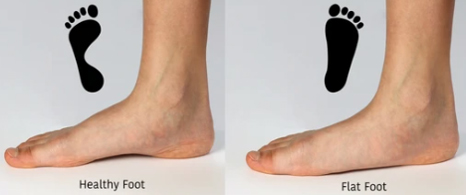
TYPES OF FLAT FEET
1. Flexible Flat Foot
This is the most common type.
In flexible flatfoot:
- The arch is visible when sitting or standing on tiptoes.
- The arch disappears when standing normally.
- Foot joints remain mobile.
- Many patients are asymptomatic.
Flexible flatfoot is frequently seen in children and young adults and often does not require treatment unless symptoms develop. If you have a symptomatic flatfoot, it is better to get evaluated by a Foot and Ankle surgeon.
2. Rigid Flat Foot
In rigid flatfoot:
- The arch is absent in both standing and sitting positions.
- Foot movements are restricted.
- Pain is more common.
- Underlying structural abnormalities are often present.
Rigid flatfoot usually requires detailed evaluation and sometimes surgical intervention by a Foot and Ankle surgeon.
CAUSES OF FLAT FEET
Flat feet may be present from childhood or develop later in life.
1. Children
Flexible Flatfoot:
Most infants and young children naturally have flat feet because the arch develops gradually with age. Unless symptomatic, it rarely requires any intervention.
Tarsal Coalition:
This occurs when two or more bones are abnormally connected.
Features include:
- Stiff flatfoot
- Recurrent ankle sprains
- Pain during physical activity
- Restricted foot movements
Vertical Talus:
A rare congenital deformity where the foot arch is reversed, producing a "rocker-bottom" appearance.
2. Adults
Posterior Tibial Tendon Dysfunction (PTTD):
The posterior tibial tendon is one of the most important structures supporting the arch.
Damage or degeneration of this tendon can result in:
- Progressive flattening of the foot
- Pain along the inner side of the ankle
- Difficulty walking
- Adult-acquired flatfoot deformity
This is one of the most common causes of flatfoot in adults.
Obesity:
Excess body weight places additional stress on the arch-supporting structures, increasing the risk of arch collapse. Though not the main cause, it can be a contributory factor.
Aging:
With age, ligaments and tendons lose strength and elasticity, contributing to flatfoot deformity.
Trauma:
Flatfoot may develop after:
- Fractures around the foot and ankle
- Ligament injuries
- Tendon ruptures
- Repeated ankle sprains
Inflammatory Arthritis:
Conditions such as:
- Rheumatoid arthritis
- Psoriatic arthritis
- Ankylosing spondylitis
can weaken joints and supporting structures, resulting in progressive deformity.
Neurological Disorders:
Certain neurological conditions may cause muscle imbalance and arch collapse, including:
- Cerebral palsy
- Charcot-Marie-Tooth disease
- Stroke-related muscle weakness
Diabetes:
Long-standing diabetes may lead to:
- Tendon degeneration
- Ligament laxity
- Charcot neuroarthropathy
SYMPTOMS OF FLAT FEET
Symptoms vary depending on the severity and underlying cause.
Many individuals remain symptom-free. Others may experience significant discomfort.
In my clinical practice the most common symptoms include:
Foot Pain
Pain may occur:
- Along the inside of the ankle
- In the arch
- Around the heel
- In the midfoot
Pain often worsens after prolonged standing or walking.
Swelling
Swelling may develop around the inner ankle, especially when the posterior tibial tendon is involved.
Fatigue
Patients frequently report:
- Tired feet
- Difficulty walking long distances
- Reduced endurance during sports
Difficulty Standing on Tiptoes
Patients with posterior tibial tendon dysfunction often struggle to perform a single-leg heel raise.
Change in Foot Shape
Typical findings include:
- Arch collapse
- Outward turning of the heel
- Forefoot drifting outward
- Increased shoe wear on one side (One of the initial signs in severe flatfoot along with pain)
Recurrent Ankle Sprains
Loss of normal foot alignment can make the ankle unstable.
Knee, Hip and Back Pain
Abnormal biomechanics can affect the entire lower limb, resulting in:
- Knee pain
- Hip discomfort
- Lower back pain
CLINICAL EVALUATION
A thorough clinical examination is essential to determine the cause and severity of flatfoot.
As an orthopaedic foot and ankle specialist I will assess:
- Foot alignment
- Arch height
- Heel position
- Gait pattern
- Joint mobility
- Muscle strength
- Tendon function
Several specialized tests may be performed like Single Heel Rise Test, Jack’s test etc for additional clinical evaluation.
INVESTIGATIONS
X-rays:
Weight-bearing X-rays are the most important imaging study.
They help assess:
- Arch collapse
- Joint alignment
- Arthritis
- Severity of deformity
Common radiographic measurements include:
- Meary's angle
- Calcaneal pitch
- Talonavicular coverage angle
Weight-bearing radiographs provide valuable information for diagnosis and treatment planning.
MRI Scan:
MRI is useful for evaluating:
- Posterior tibial tendon tears
- Tendon degeneration
- Ligament injuries
- Cartilage damage
- Bone marrow changes
MRI is especially helpful in symptomatic adult-acquired flatfoot.
CT Scan:
CT scanning is valuable for:
- Tarsal coalition
- Complex deformities
- Arthritis assessment
- Pre-operative planning
Three-dimensional reconstruction allows detailed visualization of foot anatomy and for pre-operative planning.
Ultrasound:
Ultrasound may be used to evaluate:
- Tendons
- Ligaments
- Dynamic movement abnormalities
It is less expensive and provides real-time assessment. Though I rarely use it in my clinical practice.
TREATMENT OF FLAT FEET
Treatment depends on:
- Age
- Severity
- Cause
- Symptoms
- Degree of deformity
Not all flat feet require treatment. You need to consult a Foot and Ankle Surgeon for proper evaluation and treatment guidance.
Non-Surgical Treatment:
Most patients improve with conservative management.
Activity Modification:
Reducing activities that aggravate symptoms can decrease pain and inflammation.
Examples include:
- Limiting prolonged standing
- Reducing high-impact sports
- Avoiding uneven surfaces
Footwear Modification
Proper footwear plays a crucial role.
Ideal shoes should provide:
- Good arch support
- Firm heel counter
- Shock absorption
- Stability
Unsupportive footwear such as worn-out sandals may worsen symptoms.
Orthotics (most important)
Custom orthotic insoles are the mainstay treatment initially for symptomatic flatfeet. Every foot is different in measurement; hence custom orthotic insoles are ideal over market available insoles. They help by:
- Supporting the arch
- Improve alignment
- Reduce pain
- Enhance walking efficiency
Orthotics are particularly beneficial in flexible flatfoot and early-stage adult-acquired flatfoot.
Physiotherapy
A structured rehabilitation program can strengthen foot and ankle muscles. Though their benefit may be mild to moderate.
Exercises may include:
- Calf Stretching - Helps improve ankle flexibility.
- Posterior Tibial Strengthening - Targets the primary arch-supporting tendon.
- Heel Raises - Improve muscle endurance and arch support.
- Balance Training - Enhances stability and reduces the risk of falls and ankle sprains.
Weight Reduction
In overweight patients, weight loss significantly reduces stress on the foot and may improve symptoms.
Medications
Pain-relieving medications may be prescribed, including:
- Paracetamol
- Non-steroidal anti-inflammatory drugs (NSAIDs)
This help control pain and inflammation but do not correct the deformity itself.
Bracing
An ankle-foot orthosis (AFO) may be recommended in:
- Severe deformity
- Posterior tibial tendon dysfunction
- Elderly patients unsuitable for surgery
Bracing can provide excellent symptom relief in unfit patients.
Surgical Treatment:
Surgery is considered when:
- Conservative treatment fails
- Progressive deformity occurs
- Significant pain persists
- Arthritis develops
The surgical procedure depends on the stage and cause of flatfoot. It may range from simple tendon transfer to complex bony and ligamentous reconstruction. In my clinical practice, 20-30% patients with symptomatic flatfeet may end up requiring surgery.
Tendon Reconstruction
Used primarily in early adult-acquired flatfoot.
Procedures may include:
- Posterior tibial tendon repair
- Flexor digitorum longus tendon transfer
These procedures restore tendon function and support the arch.
Calcaneal Osteotomy
The valgus heel bone is cut and repositioned to improve alignment.
Benefits include:
- Improved foot mechanics
- Better weight distribution
- Long-term correction
Lateral Column Lengthening
This procedure corrects forefoot abduction and restores arch height.
It is commonly performed in severe forefoot abduction deformities.
Medial Column Procedures
In selected patients, procedures involving the navicular or first ray may be necessary to improve alignment. This may include Lapidus procedure or spring ligament repair depending upon the cause and severity of flatfoot.
Arthrodesis (Fusion Surgery)
Fusion is generally reserved for:
- Rigid flatfoot
- Advanced arthritis
Common fusion procedures include:
- Subtalar fusion
- Talonavicular fusion
- Triple arthrodesis
Fusion eliminates painful motion and provides a stable foot.
Treatment of Tarsal Coalition
Tarsal Coalition leads to rigid flatfoot seen commonly in children and adolescents. Management depends on age and severity.
Options include:
- Activity modification
- Orthotics
- Surgical excision of the coalition
- Fusion procedures in advanced cases
RECOVERY AFTER SURGERY
Recovery varies according to the procedure performed.
Typically:
- Non-weight-bearing for 6–8 weeks
- Progressive rehabilitation
- Physiotherapy
- Gradual return to activities
Most patients experience substantial pain relief and improved function following successful correction.
Can Flat Feet Be Prevented?
Not all cases can be prevented, particularly congenital forms.
However, the following measures may reduce the risk of progression:
- Maintaining healthy body weight
- Wearing supportive footwear
- Treating ankle injuries promptly
- Strengthening foot and ankle muscles
- Seeking early medical evaluation when symptoms develope
When Should You Consult a Foot and Ankle Specialist?
Seek medical attention if you experience:
- Persistent foot pain
- Progressive flattening of the arch
- Difficulty walking
- Recurrent ankle sprains
- Swelling around the ankle
- Inability to stand on tiptoes
- Foot deformity affecting daily activities
Early intervention often leads to better outcomes and may prevent the need for major surgery.
Frequently Asked Questions
1. Are flat feet always a problem?
No. Many people have flat feet without symptoms. Treatment is only required when pain, deformity, or functional limitations occur.
2. Can flat feet cause knee and back pain?
Yes. Altered foot mechanics can affect the alignment of the entire lower limb, contributing to knee, hip, and lower back pain.
3. Do children with flat feet need treatment?
Most children have flexible flat feet that improve naturally with growth. Treatment is usually needed only if symptoms are present.
4. Can exercises cure flat feet?
Exercises cannot completely change foot structure in all cases, but they can strengthen supporting muscles, reduce symptoms, and improve function.
5. Are orthotics effective?
Yes. Orthotic insoles can provide support, improve alignment, and reduce pain, especially in flexible flatfoot and early-stage adult-acquired flatfoot.
6. Can flat feet worsen with age?
Yes. Adult-acquired flatfoot may progressively worsen, particularly when caused by posterior tibial tendon dysfunction.
7. Is surgery always necessary?
No. Most patients respond well to non-surgical treatment. Surgery is reserved for persistent symptoms, progressive deformity, or arthritis.
8. How long does recovery take after flatfoot surgery?
Recovery varies depending on the procedure but typically ranges from 6 weeks to 3 months for complete rehabilitation.
9. Can flat feet affect sports performance?
In some individuals, flat feet may lead to fatigue, pain, or reduced efficiency during athletic activities. Proper footwear and orthotics can help.
10. What is the best treatment for adult-acquired flatfoot?
Treatment depends on the stage of the disease. Early stages often respond to orthotics and physiotherapy, while advanced deformities may require reconstructive surgery or fusion procedures.
If you are a patient from Thane, Mumbai or Navi Mumbai schedule a consultation with Dr Vivek Maurya for comprehensive foot and ankle evaluation and evidence-based treatment.