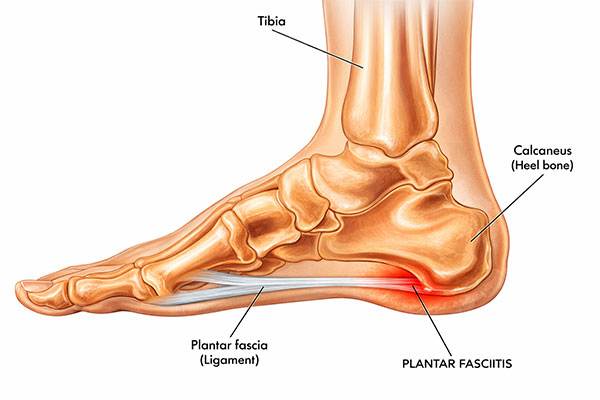
1️. Repetitive Microtrauma
Continuous strain leads to microtears at the heel insertion. Repetitive micro trauma from running, dancing, or jumping can damage the fascia leading to Plantar Fasciitis. Similarly prolonged standing on hard surfaces, improper footwear can contribute to the condition.
Typical site of pain is at the medial heel.
What are the symptoms of Plantar Fasciitis?
The hallmark symptom is sharp heel pain typically with the first step in the morning. But every heel pain is not Plantar Fasciitis
Treatment
Most patients (90–95%) improve with conservative treatment within 2 months. However, refractory or chronic cases may take longer.
Activity Modification
- Reduce high-impact activities like running, jumping or dancing. A period of rest of few weeks is needed to reduce the inflammation.
- Switch to cycling or swimming temporarily. This reduces the strain on plantar fascia by offloading it.
Footwear Correction
- Proper arch support
- Cushioned heel
- Avoid barefoot walking on hard surfaces
Stretching Protocol (MOST IMPORTANT)
Addresses the root cause and helps in symptomatic relief when done properly. Visit a specialist to learn more about proper stretching protocols.
- Plantar fascia stretching
- Calf (gastrocnemius-soleus) stretching
- Towel stretch exercises
Medications
- Short course non-steroidal anti-inflammatory drugs (for symptomatic relief): Usually started in conjunction with physiotherapy.
- Topical anti-inflammatory gels provide temporary pain relief.
Ice Therapy
- Ice massage using a frozen bottle for 10–15 minutes.
Orthotics
- Silicone heel cups: Provides adequate cushioning.
- Night splints: Helps keep the plantar fascia stretched at night thereby reducing early morning pain.
Injection Therapy (Selected/ Refractory Cases)
- Corticosteroid injections (judicious use only): Should only be used when conservative management fails to reduce the symptoms. They provide symptomatic relief for few months. However, improper placement of injection can lead to necrosis or atrophy of plantar heel pad. Hence, consulting a Foot and Ankle specialist is necessary to prevent such a complication.
- Platelet-rich plasma (PRP) therapy (controversial): May or may not be beneficial.
Shockwave Therapy
- Extracorporeal shockwave therapy (ESWT): It has shown some benefits in resistant or chronic cases.
Surgery (Rare)
Reserved for persistent cases not responding after 6–12 months:
- Partial plantar fascia release: Only the medial plantar fascia is released leaving the lateral side intact. It relieves the strain on plantar fascia
- Proximal gastrocnemius release: Reduces the stress via the Achilles tendon on the calcaneus
Recovery timeline
A structured rehabilitation protocol is necessary to treat Plantar Fasciitis. With proper treatment most people recover in approximately 2 months(6-12 weeks). However, chronic and resistant cases may take a longer time period.
1) Why does Plantar fasciitis cause more pain in the morning?
In sleep the plantar fascia tightens. Upon getting up the fascia stretches, thereby causing pain. Hence, night splints are recommended as they keep plantar fascia stretched at rest.
2) Can Plantar Fasciitis cause pain all day long?
The classical presentation is early morning pain or pain after prolonged rest. However, in chronic cases there maybe discomfort throughout the day.
3) How long does Plantar fasciitis last?
With proper treatment most patients improve in about 2 months period. However, refractory and chronic cases may last longer and need to be evaluated by a Foot and Ankle Orthopaedic surgeon.
4) How to diagnose Plantar Fasciitis?
Diagnosis is clinical based on symptoms and examinations. Radiographs and MRI may be additionally needed in severe cases. Hence, consulting a specialist is of utmost importance.
5) Does heel spur lead to Plantar Fasciitis?
Heel spur is a secondary reaction due to chronic Plantar Fasciitis. It is not the cause but an after-effect of Plantar Fasciitis.
6) What is the best treatment for Plantar Fasciitis?
Ideal treatment is highly individualized and is usually a combination of stretching exercises, activity modification, proper footwear and anti-inflammatory medications. Staged physiotherapy and regular follow ups may be needed.
7) Do shoe inserts or in-soles help?
Yes. They provide a cushioning effect and can help relieve the strain on plantar fascia. However, custom orthotics may sometimes be needed.
8) Are steroid injections safe?
They may provide symptomatic relief in severe cases but the effect may be short-lived and Plantar Fasciitis may recur. Frequent injections are avoided as it may lead to weakening and rupture of fascia. Hence, they must only be used under an expert guidance.
9) Can weight gain lead to Plantar Fasciitis?
Though not the main cause, increased body weight places additional strain on plantar fascia and can aggravate the condition.
10) Who is at risk for developing Plantar Fasciitis?
People who stand for long hours like workers, teachers, medical professionals etc are at increased risk. Also runners, athletes or people with flat feet/ high arch are predisposed to develop Plantar Fasciitis.
11) Is Plantar Fasciitis a genetic condition?
No. It is not transmitted genetically. However, your foot type and body mechanics may have a familial inheritance leading to increased predisposition for certain foot conditions including Plantar Fasciitis.
12) Is surgery required for Plantar Fasciitis?
Maybe needed in advanced or refractory stage (3-5% of the cases). It is considered only when there is no relief in pain despite proper conservative management for 6-12 months.
13) Can Plantar Fasciitis recur again?
If improperly treated Plantar Fasciitis is known to recur.
14) Can both feet be affected?
Though not a rule, but both feet can be affected.
15) Whom should I consult for Plantar Fasciitis?
Every heel pain is not Plantar Fasciitis. Foot and ankle injuries require specialized understanding of joint biomechanics. A dedicated foot and ankle surgeon provides more precise diagnosis and advanced surgical techniques compared to general treatment.